How Reflow Profiling Impacts PCB Assembly Reliability
In Surface Mount Technology (SMT), reflow soldering is one of the most critical stages of the assembly process. While component placement and solder paste printing receive significant attention, the reliability of the final product often depends heavily on one controlled variable — the reflow profile.
For manufacturers offering PCB Assembly services, optimizing reflow profiling is essential to ensure solder joint integrity, long-term reliability, and consistent production yield.
What Is Reflow Profiling?
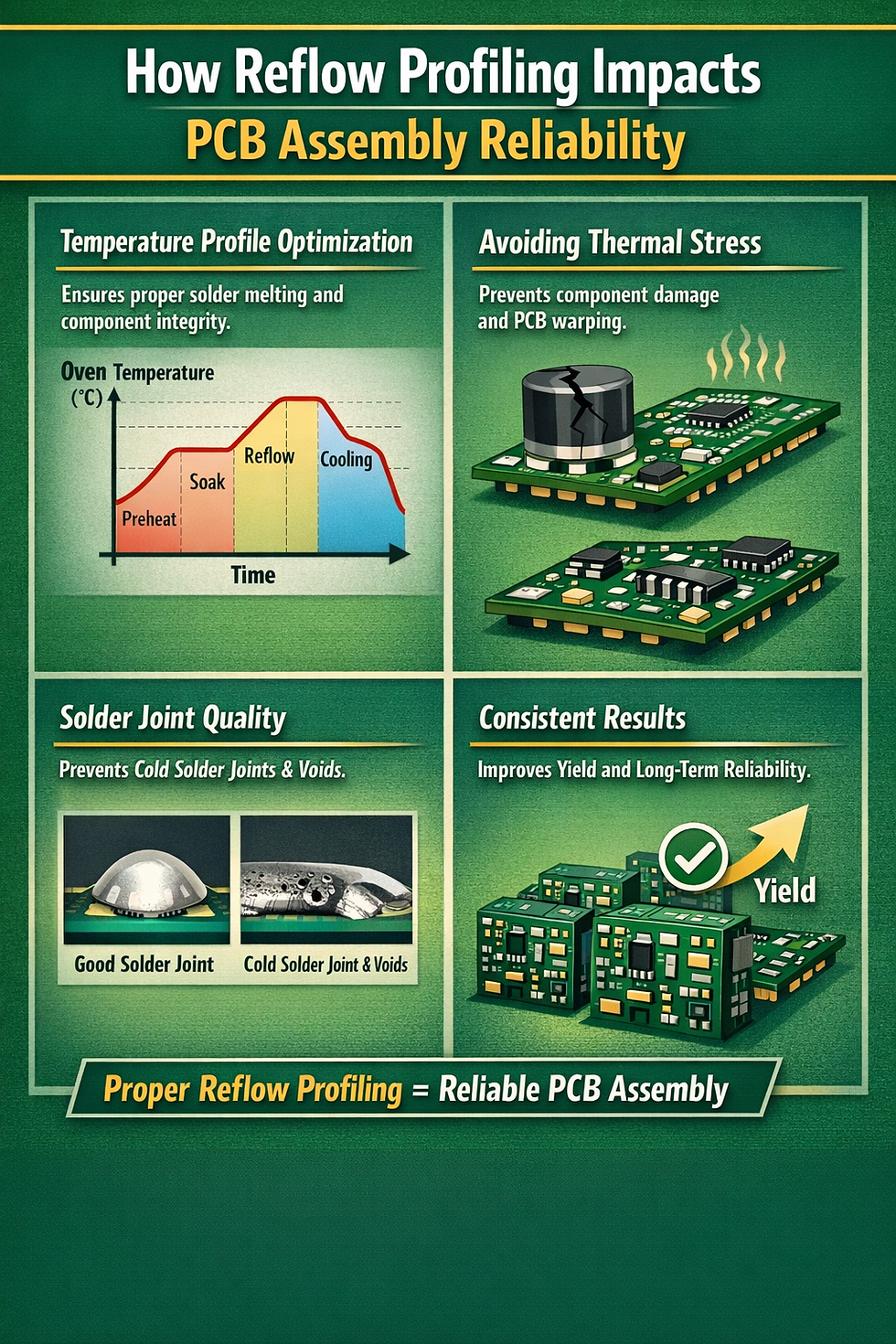
Reflow profiling refers to the controlled heating and cooling cycle that a PCB undergoes inside a reflow oven to form reliable solder joints. A standard reflow profile consists of four key stages:
Preheat Zone – Gradual temperature rise to activate flux and remove moisture
Soak Zone – Stabilizes board temperature and prepares solder paste for melting
Reflow (Time Above Liquidus) – Solder melts and forms metallurgical bonds
Cooling Zone – Controlled cooling to solidify solder joints properly
Each stage must be precisely controlled to avoid defects that compromise reliability.
Why Reflow Profiling Matters in PCB Assembly
A poorly optimized reflow profile can result in defects such as:
Cold solder joints
Tombstoning
Solder bridging
Voiding under BGAs
Component cracking
Delamination
These issues may not always be immediately visible but can significantly reduce product lifespan in the field.
Professional PCB Assembly services rely on validated thermal profiling to maintain consistent solder joint quality across production batches.
Key Parameters That Influence Reliability
1. Ramp Rate (Temperature Rise Speed)
If the ramp rate is too fast:
Components may experience thermal shock
Moisture-sensitive components can crack
If too slow:
Flux may degrade prematurely
Controlled ramp rates improve solder wetting and reduce mechanical stress.
Soak Time and Temperature
The soak stage ensures even heat distribution across the PCB. Uneven heating can lead to:
Warpage
Inconsistent solder flow
BGA void formation
Balanced soak settings help stabilize multi-layer boards and high-density designs.
3.Time Above Liquidus (TAL)
This is the duration the solder remains molten. Insufficient TAL can cause weak joints, while excessive TAL may:
Damage components
Cause intermetallic overgrowth
Increase brittleness
Reliable PCB Assembly services carefully monitor TAL to maintain joint strength without degrading components.
4. Peak Temperature
Peak temperature must align with solder paste specifications and component tolerances.
Excessive peak temperature can:
Damage IC packages
Cause board discoloration
Affect component reliability
Too low a peak temperature results in incomplete solder reflow.
5. Controlled Cooling Rate
Cooling influences grain structure within the solder joint. Rapid cooling may create brittle joints, while slow cooling can increase voiding risks.
Optimized cooling improves mechanical strength and fatigue resistance.
Impact on Long-Term Product Performance
Reflow profiling directly affects:
Mechanical durability
Thermal cycling resistance
Vibration tolerance
Electrical conductivity
Field reliability
In industries such as consumer electronics, automotive, and industrial systems, improper profiling may lead to premature failures under real-world stress conditions.
Challenges in Modern PCB Designs
As PCBs become more complex, reflow profiling becomes more demanding due to:
High-density interconnect (HDI) boards
Mixed component technologies
Large thermal mass variations
Lead-free solder requirements
Double-sided assemblies
Advanced PCB Assembly services use thermal profiling tools and data logging systems to validate oven performance for different board configurations.
Lead-Free Solder and Profiling Complexity
Lead-free solder alloys require higher peak temperatures compared to traditional leaded solder. This increases thermal stress on components and boards.
Careful profile optimization is necessary to balance:
Component safety
Flux activation
Solder wetting
Compliance with RoHS standards
Improper profiling in lead-free processes can significantly reduce assembly reliability.
Conclusion
Reflow profiling is not merely a temperature setting — it is a critical reliability driver in PCB assembly. The quality of solder joints formed during this process directly determines mechanical strength, electrical integrity, and long-term performance.
For manufacturers delivering professional PCB Assembly services, precise reflow profiling is fundamental to maintaining yield stability, minimizing defects, and ensuring field reliability. As electronic designs continue to evolve in complexity and miniaturization, thermal control in the reflow process will remain a decisive factor in assembly quality and product durability.


Comments